I am currently pursuing my Ph.D. degree at the College of Control Science and Engineering at Zhejiang University since 2023, where I work in the April Lab under the supervision of Prof. Yong Liu. Alongside my doctoral studies, I am a research intern at the Institute of Artificial Intelligence of China Telecom (TeleAI). Prior to this, I received my B.Eng. degree in Intelligence Science and Technology from Hangzhou Dianzi University in 2023 under the guidance of Prof. Qiuxuan Wu.
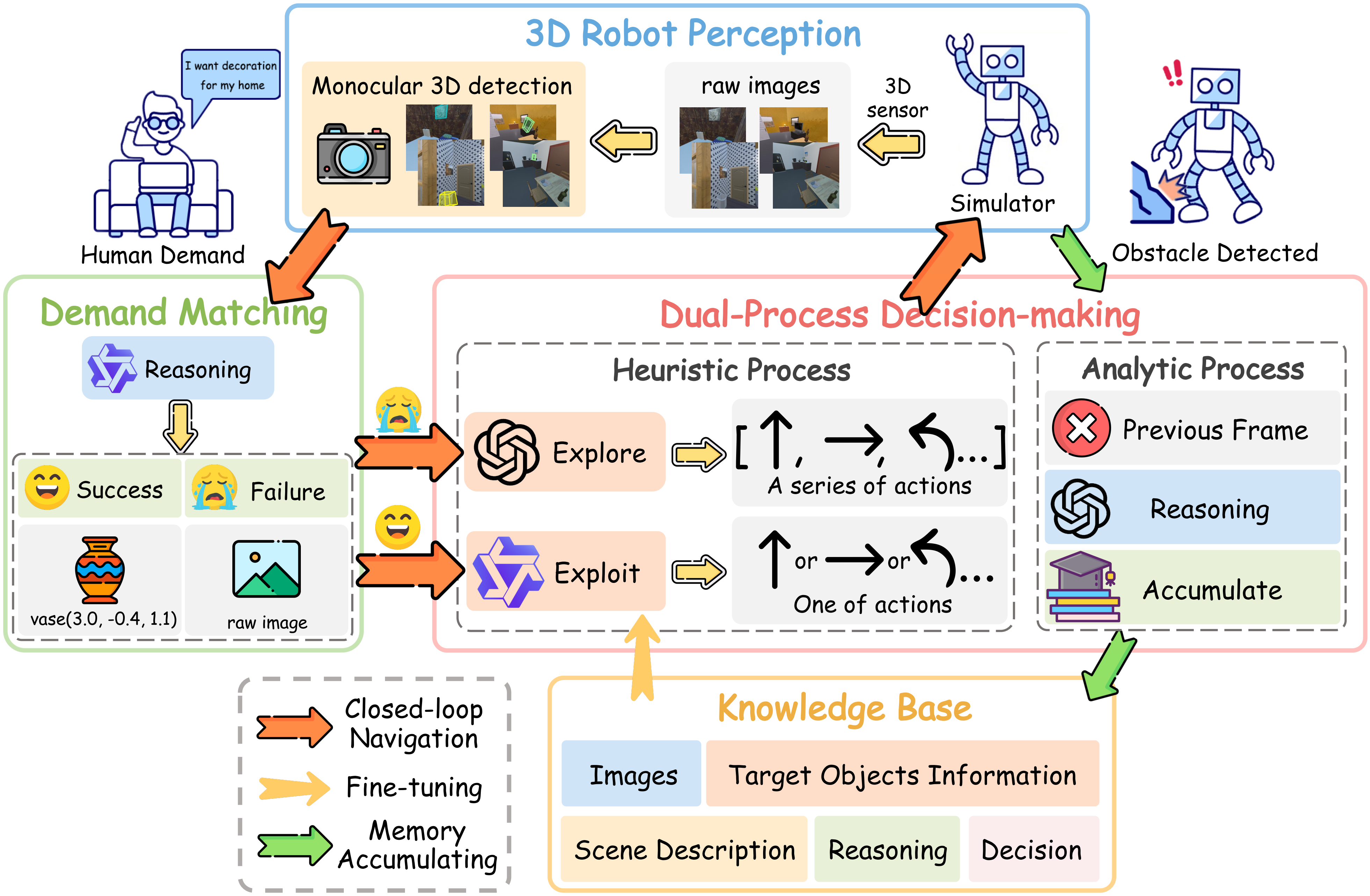
Mobile robots are increasingly required to navigate and interact within unknown and unstructured environments to meet human demands. Demand-driven navigation (DDN) enables robots to identify and locate objects based on implicit human intent, even when object locations are unknown. However, traditional data-driven DDN methods rely on pre-collected data for model training and decision-making, limiting their generalization capability in unseen scenarios. In this paper, we propose CogDDN, a VLM-based framework that emulates the human cognitive and learning mechanisms by integrating fast and slow thinking systems and selectively identifying key objects essential to fulfilling user demands. CogDDN identifies appropriate target objects by semantically aligning detected objects with the given instructions. Furthermore, it incorporates a dual-process decision-making module, comprising a Heuristic Process for rapid, efficient decisions and an Analytic Process that analyzes past errors, accumulates them in a knowledge base, and continuously improves performance. Chain of Thought (CoT) reasoning strengthens the decision-making process. Extensive closed-loop evaluations on the AI2Thor simulator with the ProcThor dataset show that CogDDN outperforms single-view camera-only methods by 15%, demonstrating significant improvements in navigation accuracy and adaptability. The project page is available at https://yuehaohuang.github.io/CogDDN/.
CVPR
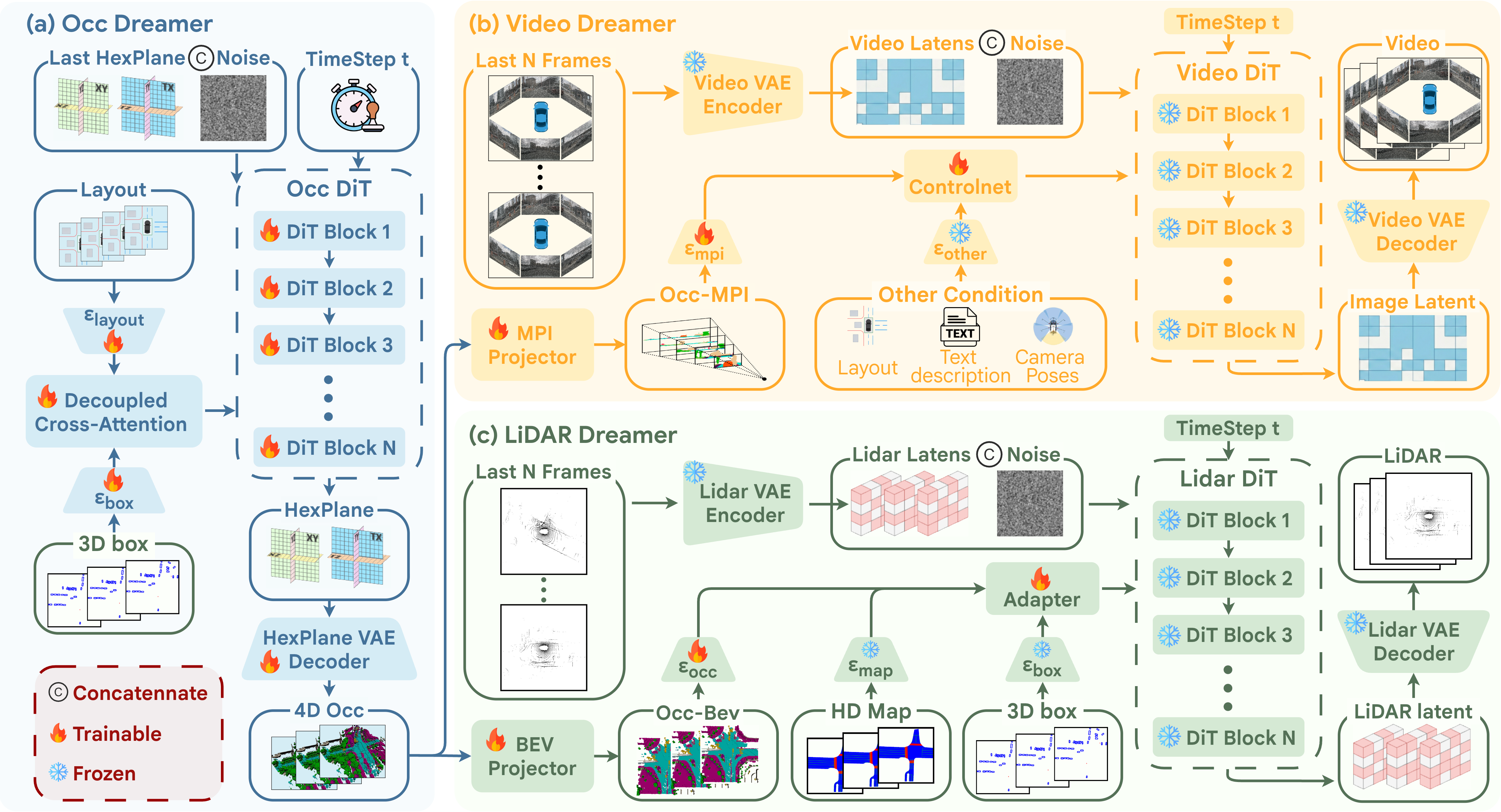
Drive-Cascade: Autoregressive Occupancy to LiDAR and Video Synthesis
Shuangming Lei*, Yuehao Huang*, Yi Yao, and 11 more authors
Mobile robots are increasingly required to navigate and interact within unknown and unstructured environments to meet human demands. Demand-driven navigation (DDN) enables robots to identify and locate objects based on implicit human intent, even when object locations are unknown. However, traditional data-driven DDN methods rely on pre-collected data for model training and decision-making, limiting their generalization capability in unseen scenarios. In this paper, we propose CogDDN, a VLM-based framework that emulates the human cognitive and learning mechanisms by integrating fast and slow thinking systems and selectively identifying key objects essential to fulfilling user demands. CogDDN identifies appropriate target objects by semantically aligning detected objects with the given instructions. Furthermore, it incorporates a dual-process decision-making module, comprising a Heuristic Process for rapid, efficient decisions and an Analytic Process that analyzes past errors, accumulates them in a knowledge base, and continuously improves performance. Chain of Thought (CoT) reasoning strengthens the decision-making process. Extensive closed-loop evaluations on the AI2Thor simulator with the ProcThor dataset show that CogDDN outperforms single-view camera-only methods by 15%, demonstrating significant improvements in navigation accuracy and adaptability. The project page is available at https://yuehaohuang.github.io/CogDDN/.
ArXiv
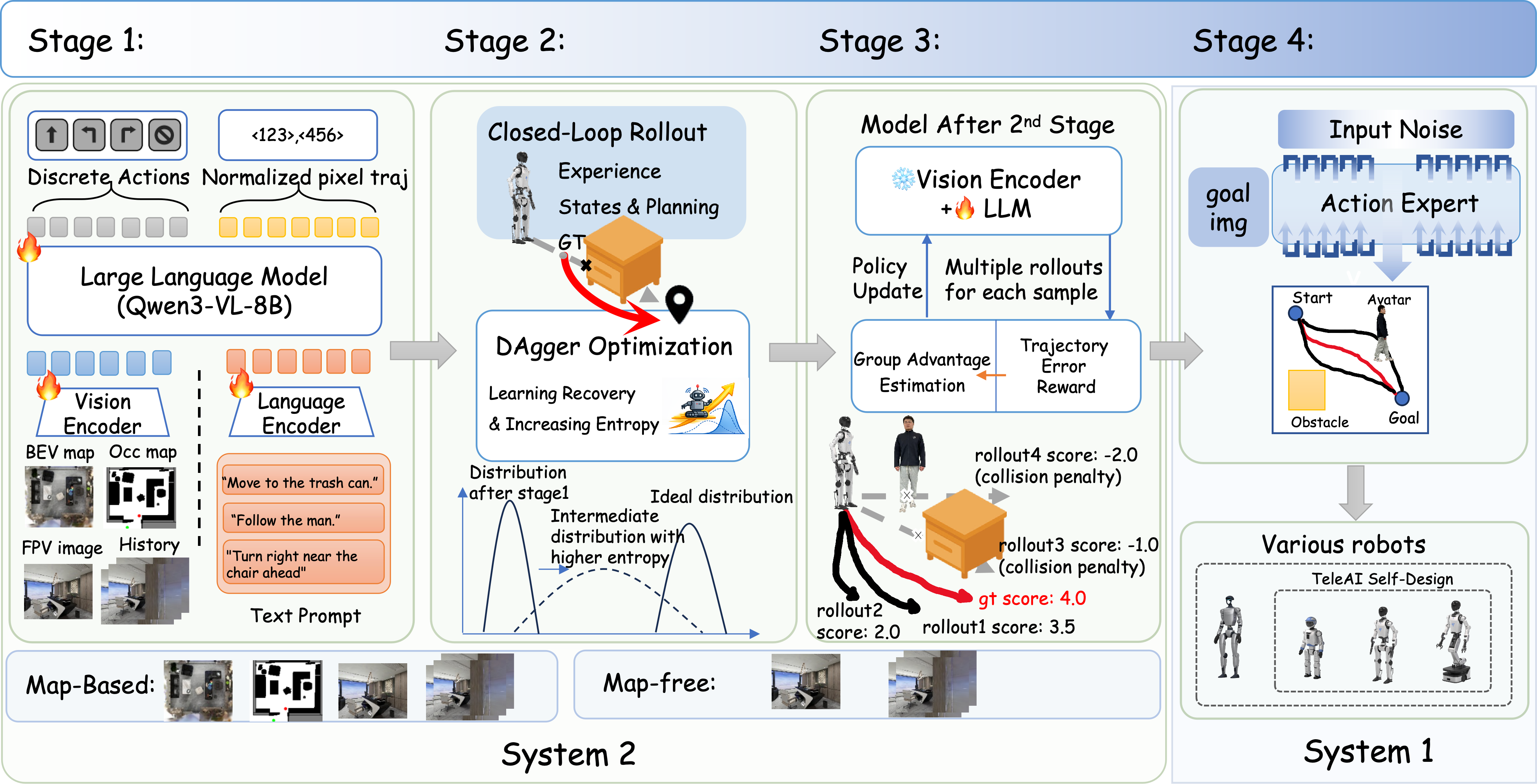
GN0: Toward a Unified Paradigm for Generation, Evaluation, and Policy Learning in Visual-Language Navigation
Xinhai Li*‡, Xiaotao Zhang*, Yuehao Huang*, and 10 more authors
Recently, world models have made significant progress in enhancing end-to-end driving systems through both future situation forecasting and improved scene understanding. However, existing driving world models are typically built upon dense scene representations, causing high computational costs and redundant information. In this paper, we present SparseWorld, a lightweight world model that focuses on predicting only the critical layout of the scene, enabling efficient future forecasting for end-to-end driving systems. SparseWorld first performs autoregressive rollout to forecast future map elements and surrounding agents, enabling the model to learn how driving scenarios evolve over time. It then leverages these predicted futures to refine downstream motion prediction and trajectory planning. Specifically, we propose a Sparse Dreamer that anticipates future instances in the latent space through joint temporal and spatial attention. By interacting with predicted future instances, the motion planner captures more accurate motion patterns and generates more informed and safety-aware trajectories. Extensive experiments demonstrate that SparseWorld significantly reduces collision risk and achieves state-of-the-art performance on the open-loop planning metrics of the nuScenes dataset with a collision rate of 0.05%. Moreover, it substantially outperforms the baseline method in closed-loop planning metrics on the Bench2Drive benchmark. Supplementary material is available at the project page: https://wryzju.github.io/SparseWorld/.
IROS
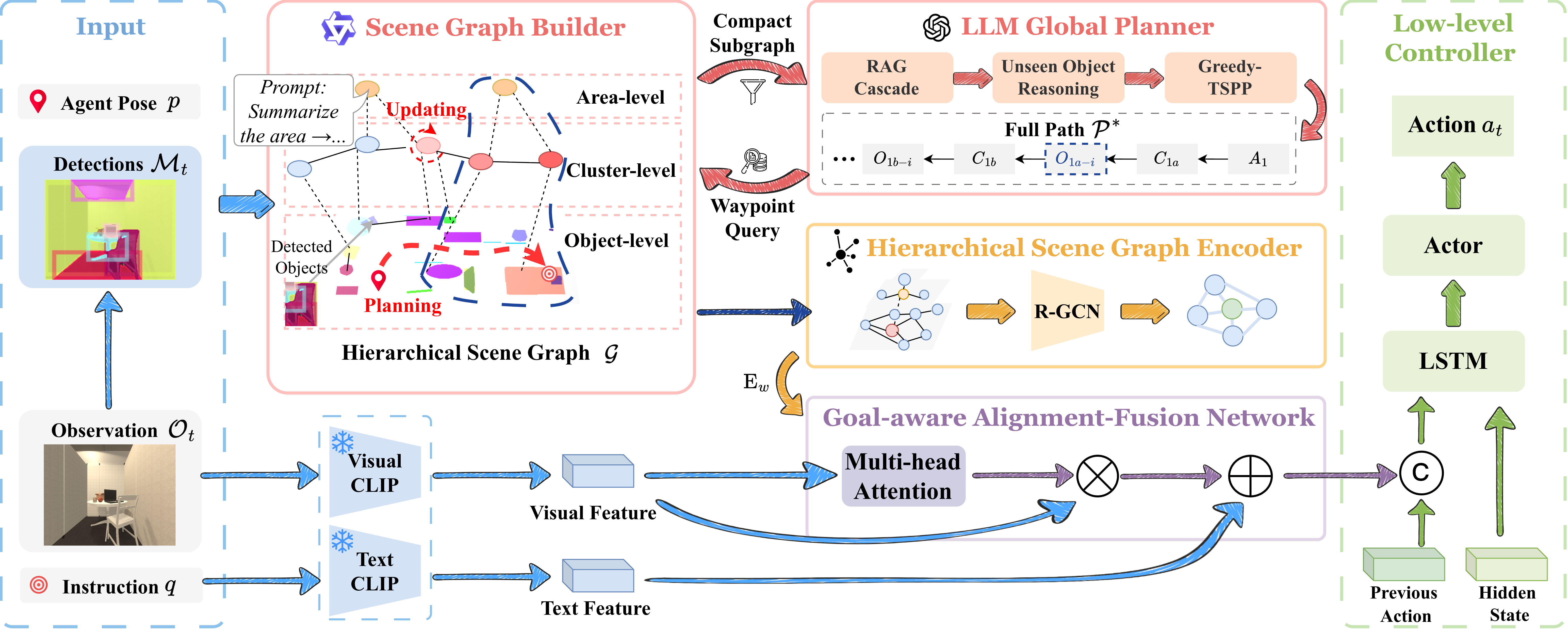
SAGE-Nav: Leveraging LLM Planning and Alignment Fusion for Hierarchical Scene Graph-Guided Navigation
Hao Su*, Yuehao Huang*, Yukai Ma, and 2 more authors
Object-Goal Navigation (ObjNav) requires embodied agents to autonomously locate specified targets relying exclusively on egocentric visual observations. Current monolithic methods often struggle with long-horizon reasoning and exhibit suboptimal generalization in novel environments. To overcome these limitations, we propose SAGE-Nav, a novel hierarchical framework that integrates the reasoning capabilities of Large Language Models (LLMs) with dynamic scene graphs. Crucially, our architecture effectively decouples asynchronous global semantic planning from the high-frequency reactive control loop. The LLM acts as a global planner, decomposing abstract instructions into a sequence of semantically grounded waypoints. To translate these plans into dense multimodal guidance, we design a Hierarchical Scene Graph Encoder (HSGE) that leverages relational graph convolutions to produce structure-aware embeddings preserving both semantic and spatial topology. Furthermore, we develop the Goal-aware Alignment-Fusion Network (GAFN) to dynamically fuse real-time perception with these structural priors. By utilizing an adaptive gating mechanism with an explicit inductive bias, GAFN ensures robust visual-topological alignment for the low-level policy. Extensive evaluations in the AI2-THOR and RoboTHOR environments demonstrate that SAGE-Nav achieves state-of-the-art performance, showcasing substantial gains in navigation efficiency and zero-shot generalizability while maintaining the minimal control latency necessary for physical robotic deployment.
You can even add a little note about which of these is the best way to reach you.